1008 Prospect Ave. NE

Location: 1008 Prospect Ave NE

1008 prospect_1954

1008 Prospect Ave, 1954, Thurston County Assessor

1008 Prospect


1008 Prospect today (2012), photo by Deb Ross

The home at 1008 Prospect Ave is located between  the Olympia Avenue National Historic District and the Bigelow House. Built in 1895, it is a good example of the type of unassuming homes that were being built in Swantown (Olympia eastside) at that time. This part of town was accessible only via an unreliable bridge before the Carlyon Fill in 1910, but was the home of several small industries that attracted workers. Photographs from the Thurston County Assessor in 1954 and by Charles M. Moore in 1949 show that the basic structure of the building is unchanged. The house is not currently inventoried.

Additional resources:

Washington State Historical Society, enter the following catalog number in collection search box C1949.1301.31.7.1

Copyright © 2022 Deborah Ross


219 Percival

Location: 219 Percival St NW

219 percival_1966 (1)

219 Percival Street in 1966, photo from Thurston County Assessor, Washington State Archives

219 Percival


219 Percival NW today (2010), photo by Deb Ross

The house at 219 North Percival on Olympia’s West Side was built in about 1897. It is another example of the tidy Victorian cottages built on lots developed by Sam Woodruff. It has not yet been  inventoried but appears to be in good condition, with original shingling intact.

For more information follow these links:

Washington State Historical Society enter the following catalog number in collection search box: C1964.26.4.20.4

Copyright © 2022 Deborah Ross


2418 Otis

Location: 2418  Otis Street SE
Local Register

2418 Otis House, 1940 Thurston County Assessor, Washington State Archives

2418 Otis House today (2011), photo courtesy Department of Archaeology and Historic Preservation

This Tudor cottage in the Wildwood neighborhood was built in 1940 for Roy  Graham, a builder. It was added to the Local Register in 2018. 

For more information follow these links:

Olympia Heritage Commission Statement of Significance

Copyright © 2022 Deborah Ross


421 Quince

Location: 421 Quince Street SE

421 Quince old

421 Quince, unknown date, photo from Thurston County Assessor, Washington State Archives

421 Quince 2012


421 Quince in 2010, photo by Deborah Ross

This modest home is included here for its early date, 1880, and its original elaborate shingling. It has not been inventoried by the City; however, it was included in historian Adah Dye’s collection of photographs of early Olympia homes. Tragically, the house burned in September 2011 and the shingling was destroyed.

For more information follow these links:

Washington State Historical Society enter the following catalog number in collection search box: C1964.26.4.14.3

Copyright © 2022 Deborah Ross


7th Avenue tunnel

Location: Under 7th Avenue between Adams and Columbia
Transportation

subway construction

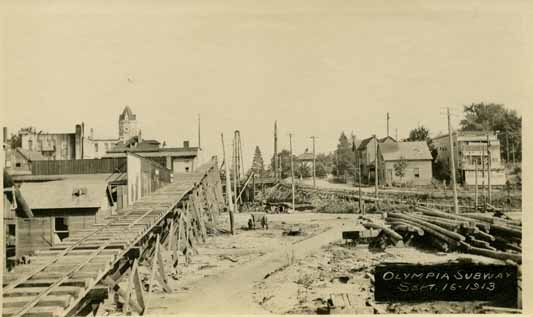
7th Avenue Tunnel 1913, photo courtesy of Washington State Historical Society

7th ave tunnel7th Avenue Tunnel today (2012), Photo by Matthew Kennelly

In early days of the Northern Pacific railroad, Olympia was ignominiously bypassed, and had to build its own narrow gauge to hook up with the NP in Tenino, 15 miles away. Once Washington gained statehood and Olympia became its permanent capital, several railroads vied for the opportunity to serve our city. However, all were contingent on concessions and funds. Olympia raised $50,000 for construction of the line to downtown, but insisted that the tracks not run on surface roads through downtown, particularly along 7th Avenue which was lined with homes of wealthy citizens.

The 7th Avenue tunnel (also known as the Subway) was opened in 1891, the year that the Northern Pacific first brought service into downtown. The depot was built on new fill at its current location on Columbia Street, just past the western end of the tunnel. At first the “lid” of the tunnel was made of wood, and considered an informal extension of Sylvester Park, which ran along its northern edge.

Improvements were made in 1913, when the tunnel was lined in concrete. Railroad historian James Hannum speculates that the set of tracks at the left of the photograph above, taken during the construction phase, may have been for a tram to bring materials to a higher level.

The tracks are still used for freight traffic, having been acquired by the Burlington Northern in the 1960s. A homeless man was hit by a train in 2010 and lost his arm.

More information:

Washington State Historical Society photo (above) enter the following catalog number in collection search box: C1984.3.1 (tunnel under construction) , C1984.3.2

Olympia inventory (note that this inventory report states the tunnel was built in 1913 or 1914, relying on information from the Burlingon Northern; however,  Sanborn maps, photographs and other DAHP sources indicate that the tunnel was built in 1891 and improved in 1913)

Thurston County Historical Journal, December 2020

Thanks to James Hannum for information and interpretation

Copyright © 2022 Deborah Ross


Acme Fuel Company

Location: 416 State Ave NE
Transportation

acmefuel_1964

Acme Fuel Co building, 1964, Thurston County Assessor, Southwest Regional Archives


acme fuel

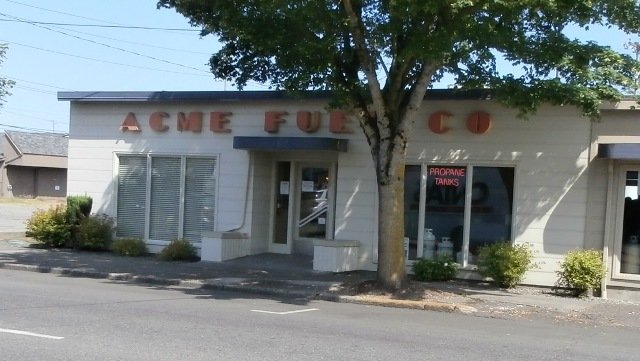
Acme Fuel Co building today (2015), photo by Deb Ross

The Acme Fuel Company was founded in 1925 by the Springer Mill Company as a way to sell off their waste wood products to homes for heating needs. They soon began selling coal and heating oil as those energy sources became more common. The art moderne style building currently housing the business was erected in 1940. The business has been owned by the Allen family since the early 1940s, and a third generation of Allens are now running the company, which continues to deliver fuel for homes and businesses in the area.

Links:

Olympia inventory

Looking Back article, July 13, 2014 (fuel truck at Legislative Building)

Thurstontalk.com article, accessed May 29, 2015

Copyright © 2022 Deborah Ross


Adams, John and Elise House

Location: 135 Cushing St NW
Local register; Diversity: Scandinavians

Adams House _1939

Adams House 1939, image from Thurston County Assessor files, Washington State Archives

Adams House

Adams House today (2010), photo by Deb Ross

The house at 135 Cushing Street NW was built around 1900, or a little earlier, and was owned by John and Elise Adams beginning in about 1902. John was a Finnish immigrant who, like many other Scandinavians in Olympia, worked at the cooperative Olympia Veneer Company. He was also active in the Swedish church, now Gloria Dei. In 1939 or 1940, when historian Adah Dye took photographs of structures over 50 years old, she called it the Mower House, perhaps a misspelling of one of the early owners, the Marry family. This home is another example of a simple pioneer style Westside home in an area originally platted by developer Samuel Woodruff.  It was added to the local register in 2013.

For more information follow these links:

Washington State Historical Society (enter the following catalog number in Collections Search box): C1964.26.4.3.7

Olympia Heritage inventory

Copyright © 2022 Deborah Ross


Adams/Martin House

Location: 1639 Bigelow Ave NE
Local register

adamsmartin_1939

Adams/Martin House, 1939, Thurston County Assessor, Southwest Regional Archives


Adams-Martin House

Adams/Martin House today (2013), photo by Marisa Merkel

The Adams/Martin House is an attractive small bungalow in the Bigelow Highlands neighborhood. It was built in 1927 by J.B. and Ella Prilman Adams. Adams was listed as a carpenter and may have built the house himself. It has fine, well-preserved Craftsman style features. The Bigelow Highlands neighborhood is known for having a number of homes that were built for workers in the mills and other industry on the waterfront (see Rebecca Christie’s book, Workingman’s Hill). The home is on the local register.

Olympia Inventory report

Copyright © 2022 Deborah Ross


Agnew Duplex

Location: 1023 Olympia Ave NE
Local register; Olympia Avenue Historical District

agnew1938

Agnew Duplex, 1938, Thurston County Assessor, Southwest Regional Archives


OLYMPUS DIGITAL CAMERA

Agnew Duplex today (2014), photo by Deb Ross

The Agnew Duplex was built in 1926 for Elsie and Clifford Agnew. The Agnews owned the City Dye Works and Star Laundry (it’s possible the woman pictured in the link at the Star Laundry page is Elsie). Duplexes were unusual at the time, and the Agnews apparently lived on one side and rented out the other side to millworkers and others. It is notable that the very large tree that is in the front yard in 2014 did not exist in the 1939 photo at above left. The well-maintained home is on the local register, as well as located in the Olympia Avenue Historic District.

Links:

Olympia inventory

For more information on the Agnew family, see the Residents section of this website

Copyright © 2022 Deborah Ross


Air show site/Swantown Marina/Tugboat Parthia

Location: 650 Marine Dr NE
Transportation; State and Local Register (Parthia)

wiseman landing

Fred Wiseman’s plane landing, May 18, 1911, courtesy of Washington State Historical Society


Tugboat Parthia, photo by Deborah Ross 2024

The Carlyon Fill project in 1910-1911 added 29 blocks to the central peninsula of Olympia, eliminating the Swantown Slough that had divided much of east Olympia from downtown, and adding most of what we now know as the port area. Just after the fill was completed, in 1911, aviator Fred Wiseman piloted his tiny aircraft, billed as the “fastest machine in the world,” to make several landings in the newly filled area. Wiseman went so far as to bring a film cameraman aboard, and the resulting footage was shown in local movie theaters. The little airplane is now on display at the Smithsonian’s National Postal Museum, as it was the first airplane to carry mail.

The area where Wiseman landed is now the Swantown Marina, echoing the transportation theme inaugurated by Wiseman’s historic first landing in Olympia.

The Swantown Marina at this site is the home of the Tugboat Parthia, which was acquired in 2017 by the South Sound Maritime Association. The tugboat is being restored and has been placed on the State and Local heritage registers and nominated for the National Register. 

Thanks to Emmett O’Connell for unearthing the Wiseman story and the location of “Olympia’s first airport.”

Additional resources:

Historylink article

Youtube video on early years of Port of Olympia

Nomination form (local and national) for Tugboat Parthia

Washington State Historical Society, enter the following catalog number in collection search box: C1943.2x.30

Copyright © 2022 Deborah Ross


Allen House

Location: 3217 Fairfield Rd SE
local register

Allen_1957

Allen House, 1957, Thurston County Assessor, Washington State Archives


OLYMPUS DIGITAL CAMERA

Allen House today (2013), Photo by Deb Ross

Built around 1920, The Allen House was originally located near Union and Columbia. It was moved to make way for a state parking garage in the late 1950s. The adjacent Partlow House had been moved the previous year, and the Allen House was moved to its current location, still next door to the Partlow House. It is a fine example of Dutch Colonial style. James Allen, the original owner, was a civil engineer who came to work for the state of Washington and helped to improve the state’s road system, urged on by the automobile industry and federal funds as part of the “‘Good Roads” movement. The home is on the local register.

Olympia heritage inventory

Article on James Allen and Good Roads

Washington State Historical Society, enter the following catalog number in collection search box: 2012.123.116

Copyright © 2022 Deborah Ross


American Legion Hall

Location: 219 Legion Way SW
Local, State, and National registers; Wohleb; Women’s History; Popular Culture

AR-Parish_LegionHall_1208_1950_small

American Legion Hall 1950, Susan Parish collection, Southwest Regional Archives


OLYMPUS DIGITAL CAMERA

American Legion Hall today (2014), photo by Deb Ross

The national American Legion was founded in 1919, after World War I. At that time, local newspapers estimated there were about 1,000 eligible veterans in Thurston County. They met in temporary locations for a time, and began raising funds for a permanent building in late 1920 or early 1921, securing this location at 6th (now Legion) and Water Street. The plan was for an auditorium and meeting place, where events could be held to attract the whole community, not just members of the Legion. Fundraising was slow until other organizations joined in the effort, notably the Rotarians and women’s organizations, who mobilized scores of fundraisers to solicit donations from schoolchildren, veterans, businesses and social organizations. Funds were deemed sufficient in mid-1921 to begin construction. The design for this relatively unadorned building was the work of Joseph Wohleb, who was reaching the peak of his influence in downtown Olympia and nearby residential neighborhoods.

The building was located in a solidly industrial neighborhood, surrounded by a junk store, a coke (coal) supplier, the railroad tunnel and track on Seventh Avenue, and houseboats across the street on the Deschutes Estuary. Some fundraisers, indeed, expressed concern about the “remoteness” of the location: even though it was only two blocks from Main Street (Capitol Way), the neighborhood was decidedly sketchy. Nevertheless, the building became an instant success from the day it opened on Armistice Day 1921, holding dances, boxing matches, Inaugural Balls, and other social activities and entertainment. It also hosted the National Guard, the Post Office, and a skating rink over the years. The American Legion band, formed here in 1924, has been highly ranked nationally since its inception and continues to perform 25-30 times a year.

The building is currently occupied by retail establishments and studios, after the American Legion vacated the building in 1999.

Due to its historical and architectural importance, the building is on the National as well as state and local registers. It is just outside the boundaries of the National Historic Downtown District. It anchors the western end of Legion Way, which was renamed in 1927, in honor of the Legion (see also Legion Way Trees)

Olympia Heritage Inventory

American Legion Band, see its Facebook page

YouTube video filmed at this location, about Women in World War I

Copyright © 2022 Deborah Ross


Anderson, Edward House

Location: 417 Olympic Way SW
Local register; Diversity: Scandinavians

EdwardAnderson_1939

Edward Anderson House 1939, Thurston County Assessor, Southwest Regional Archives


OLYMPUS DIGITAL CAMERA

Edward Anderson House today (2013), photo by Deb Ross

Edward Anderson was the fourth of the Swedish-born Anderson brothers, who established Tumwater Lumber Mills (TLM) Company, which designed and sold pre-cut homes. The homes were very popular and were sold throughout the country. Many of these homes still exist in Olympia (see, for example, Harmon House, which has a link to the company’s 1924 catalogue). Interestingly, Edward Anderson chose a Mission-revival style home to live in, rather than TLM’s signature Craftsman and Dutch colonial styles. It was built in 1928 and Edward moved into it in 1932. It has a nice view over Budd Inlet to downtown Olympia. The home is on the local register.

Olympia Heritage inventory

Copyright © 2022 Deborah Ross