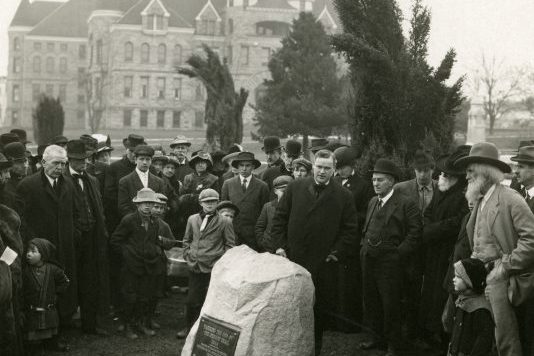
End of Oregon Trail monument dedication in 1913

Throughout 2023 the Sunday Olympian’s Looking Back theme was origins of area place names. Old Oregon Trail Road descends from near the south end of Water Street to the waterfront below I-5. Before I-5 was built, this road was called View Place. The name was changed in 1983 to recognize that this road was part of the northern segment of the Oregon Trail in Washington Territory. Shown here is the dedication of the End of the Oregon Trail marker in Sylvester Park in 1913.  

Courtesy State Capital Museum collection, Washington State Historical Society, catalog 2012.0.259

Text © Deborah Ross and The Olympian 2023

Nathaniel Crosby and Crosby Store, mid 1800s

In 2023 the Sunday Olympian’s theme for its Looking Back feature was the origins of area place names. Crosby Boulevard in Tumwater is named for the Crosby family. The Crosbys were early American settlers, arriving in Tumwater in 1851. Pictured here, third from left, is Nathaniel Crosby III, Tumwater merchant. The Crosby House in Tumwater, now a museum, was originally built by Nathaniel and his wife Cordelia Smith Crosby.  

Photo mid 1800s, Courtesy State Capital Museum collection, Washington State Historical Society, catalog C2018.0.9

Text © Deborah Ross and The Olympian 2023

Legion Way Trees in the 1920s

In 2023 the Sunday Olympian’s theme for its Looking Back feature was the origins of area place names. The American Legion was chartered by Congress in 1919 as a patriotic veterans organization, in support of World War I veterans. In honor of Olympia veterans’ service, Sixth Avenue was renamed Legion Way in 1927, and the Legion Way trees were planted in honor of veterans’ service in these and all wars. Pictured here are two Legion Way saplings, photographed around the time the trees were planted. 

Merle Junk photo, Washington State Archives, Susan Parish collection

Text © Deborah Ross and The Olympian 2023
Hazard Stevens Elk Park at Tumwater Falls late 1800s

Hazard Stevens, son of Washington Territory’s first governor, Isaac Stevens, was an investor in the Olympia Light and Power company that operated a hydroelectric facility at the Middle Tumwater Falls on the Deschutes River in Tumwater. Hazard fenced in the area below the falls and installed a menagerie of elk, swans, and bears, to attract visitors. Pictured here are some of elk with the falls in the background.  

Late 19th or early 20th century photograph, Courtesy State Capital Museum collection, Washington State Historical Society, catalog C1961.137.18

Text © Deborah Ross and The Olympian 2022

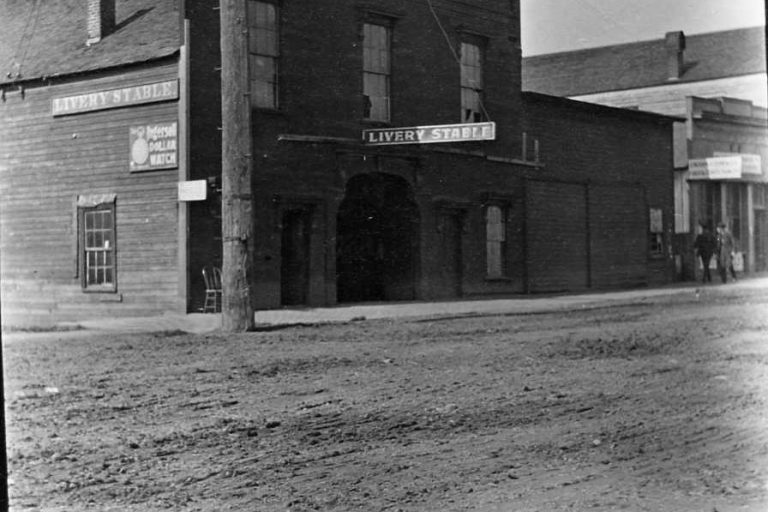
Tilley Livery Stable 1870s

For many years the northwest corner of Third Avenue and Main Street (now State and Capitol) was occupied by a livery–a combination public stable, stagecoach, and carriage rental business. The first proprietor was Moses Rice Tilley, whose father Abram operated an early inn and stagecoach stop on the route between Olympia and Longview. The business operated under different owners until 1912, when the Old City Hall and Fire Station building (currently vacant) was erected here.

Susan Parish collection, Washington State Archives, probably around 1870s

Text © Deborah Ross and The Olympian 2022

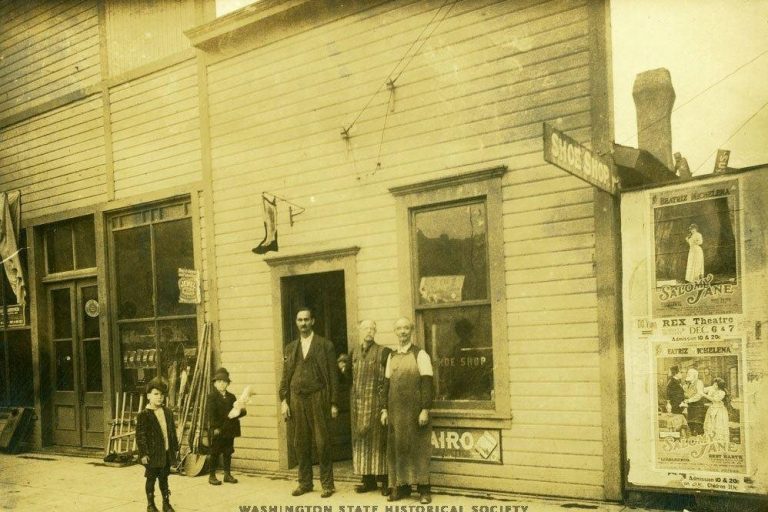
Haskin and Peele shoe shop in 1914

In 1914, photographer Robert Esterly took photographs of Olympia businesses and their owners. Pictured here is the Haskin and Peele shoe shop, located at 406 Fourth Avenue East (current site of the Clipper Café). The owners James Haskin and Robert Peele are likely two of the three men posing in front of the shop. 

Robert Esterly photograph, 1914, Courtesy State Capital Museum collection, Washington State Historical Society, catalog C1961.498.7

Text © Deborah Ross and The Olympian 2022

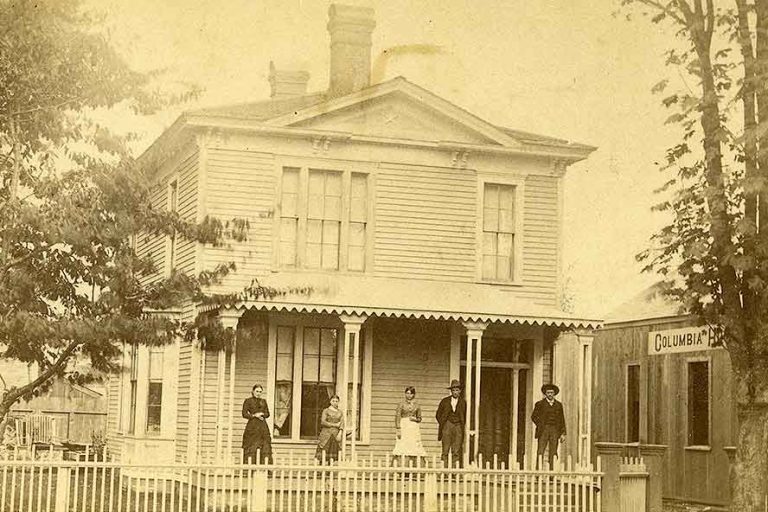
Columbia Hotel in 1870s

The Columbia Hotel was built in the mid 1800s by early Olympia settler John Clark, at what is now 114 Columbia St. NW. At the time, it was on waterfront and popular with politicians, lobbyists, and travelers. The hotel was acquired by George Carlton and renamed the Carlton Hotel; later rebuilt and enlarged. The hotel lasted until at least 1940, though its status declined due to its proximity to the deteriorating Tenderloin District north of State.

Courtesy State Capital Museum collection, Washington State Historical Society, catalog C1959.1127.13

Text © Deborah Ross and The Olympian 2022

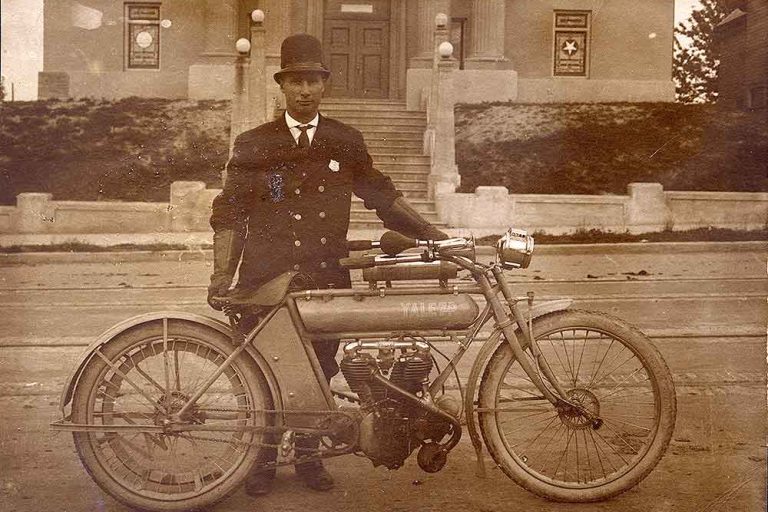
Motorcycle Officer Koepke in 1912

Fred Koepke was appointed Olympia’s motorcycle police officer in 1912. He was chosen in part for his familiarity with motorcycles and their repair. He’s pictured here in front of the Masonic Hall on Main Street (Capitol Way). His motorcycle was a Yale 7 HP (horsepower)

Photograph taken around 1912, Courtesy State Capital Museum collection, Washington State Historical Society catalog C1961.498.22

Text © Deborah Ross and The Olympian 2022

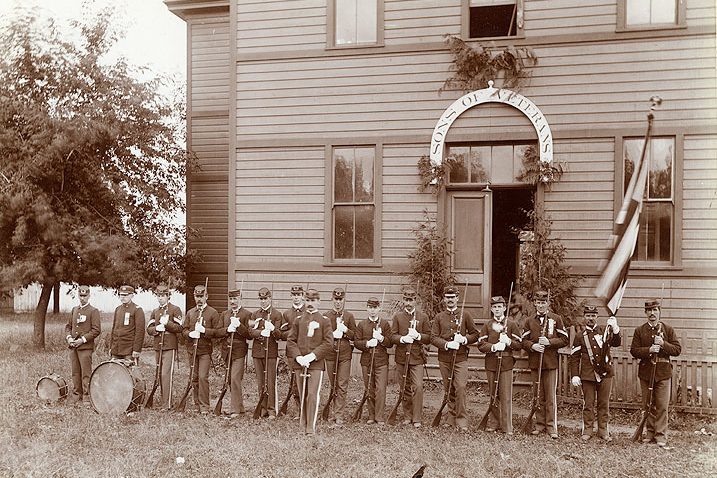
Sons of Veterans in late 1800s

The Grand Army of the Republic (GAR) was a fraternal organization of Union veterans of the American Civil War. Later, their offspring formed the Sons of Union Veterans of the Civil War. The GAR and Sons of Veterans headquarters in Olympia was the former Central School building, then located at 200 Union Avenue (the building is now moved to the corner of Union and Adams). In this photo, uniformed Sons of Veterans members pose in front of the building. 

undated photo, likely 1880-1900, Courtesy State Capital Museum collection, Washington State Historical Society, catalog C1959.267x.10

Text © Deborah Ross and The Olympian 2022

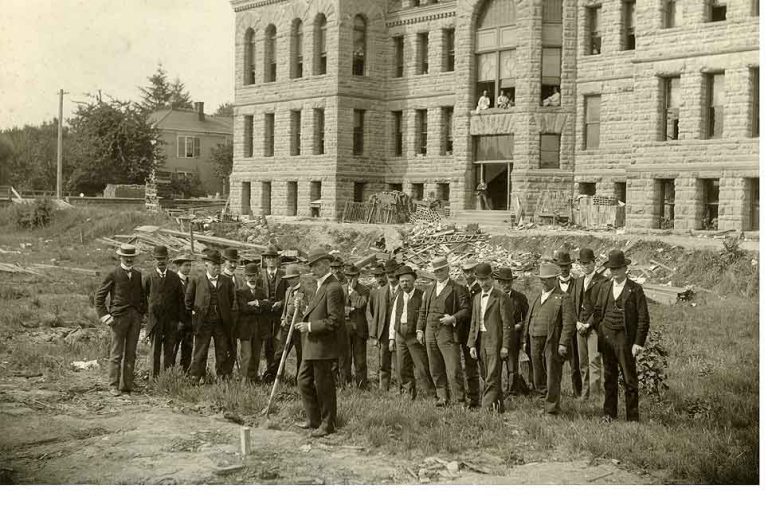
Old State Capitol Annex groundbreaking 1902

In 1901, Washington State purchased the Thurston County Courthouse, adjacent to Sylvester Park, to serve as the state’s Legislative Building. An annex to the original building was built to accommodate state government functions. This photograph from around 1902 shows the groundbreaking for the annex. Governor John R. Rogers is in front, wielding a ceremonial shovel. The building is now the office of the Superintendent of Public Instruction.

Photo 1902, Courtesy State Capital Museum collection, Washington State Historical Society, catalog C1958.181x.1. 

Text © Deborah Ross and The Olympian 2022


Hop pickers in 1889

Washington State produces the majority of hops grown in the United States. The crop, used in making beer, was first introduced in Western Washington by pioneer Ezra Meeker. Thurston County hop pickers pose in front of the crop in this photo from about 1889. Most hop pickers of that time were Native American and Chinese. Today, most commercial hops are produced in the Yakima area.  

Rogers Studio, around 1889, Courtesy State Capital Museum collection, Washington State Historical Society, catalog C1958.2.65

Text © Deborah Ross and The Olympian 2022

Union Block in 1894

This photograph of the Union Block, taken in 1894, dramatically illustrates how Olympia’s shoreline has changed over the years. The Union Block was located on Fourth Avenue between Chestnut and Cherry, approximately where City Hall is now. The building was perched on pilings over the Moxlie Creek estuary at that location.. Moxlie Creek now runs underground and empties into the eastern arm of Budd Inlet, where it meets Olympia Avenue.   

1894 photograph, Courtesy State Capital Museum collection, Washington State Historical Society, catalog C1957.134x.17

Text © Deborah Ross and The Olympian 2022

The Prices with their automobiles about 1907

The extended family of Benjamin and Agnes Mitchel Price poses proudly with their two automobiles, an REO or Red Wing, and a Winton Six, in this photo from about 1907. The building behind them was originally the Farquhar store, but then used as an annex to the Old State Capitol Building and dubbed The Lobby. The Prices were among the first automobile owners in Olympia. The photograph was taken by Agnes Mitchel Price’s sister, Ida B. Smith. Agnes and Ida were both professional photographers. 

Ida B. Smith photo, about 1907, Courtesy State Capital Museum collection, Washington State Historical Society, catalog C1951.284.3

Text © Deborah Ross and The Olympian 2022 and 2026

Olympia Knitting Mills in about 1915

Olympia Knitting Mills was an important contributor to Olympia’s economy in the early 20th century.  The factory was located on 6th (Legion) Avenue between Jefferson and Cherry, and created woolen sportswear and outwear to be shipped throughout the United States and beyond. Pictured here are co-owner Sol Meyers and his crew in the winding room. Finished garments can be seen on shelves at the rear. The building still exists. 

Photo around 1915, Courtesy State Capital Museum collection, Washington State Historical Society, catalog C1951.250.26

Text © Deborah Ross and The Olympian 2022

Olympia from the West Side late 1800s

This photo was taken in the late 1800s from the west side of Olympia. In the foreground is the elegant Percival Mansion. Below it is the Fourth Avenue Bridge that crossed the wide Deschutes Estuary, leading to downtown Olympia. The railroad track, with its depot at far left, linked Olympia to Tenino and access to the Northern Pacific Railroad. 

photo late 1800s, Courtesy State Capital Museum collection, Washington State Historical Society, catalog C1950.1301.22.1

Text © Deborah Ross and The Olympian 2022

Central School late 1800s

Pictured here, in a photo from the late 1800s, are the students and a faculty member at the Central School in Olympia, located at the corner of Union Avenue and Washington Street. The building still exists and is one of the oldest in the city: it was cut in two and moved to the corner of Union and Adams Street where it serves as an apartment complex. 

Photo, late 1800s, Courtesy State Capital Museum collection, Washington State Historical Society, catalog C1950.10.8

Text © Deborah Ross and The Olympian 2022

T.C. Van Epps Land Office in late 1800s

The Van Epps family operated several businesses in downtown Olympia in the late 19th century. Pictured here is the T.C. Van Epps Real Estate office on Main Street (now Capitol Way). The building still exists and is currently the home of Browsers Bookshop.

Photo late 1800s, Courtesy State Capital Museum collection, Washington State Historical Society, catalog C1950.3.50

Text © Deborah Ross and The Olympian 2022

Oyster Harvesting in 1920s

Oysters have been an important food source for our area’s residents since well before the arrival of non-Indigenous Americans. In this photograph from the early 20th century, harvesters are working at low tide to shovel oysters into a nearby scow. At the time this photograph was taken, harvesting was done nearly exclusively by Japanese immigrants. This process would later be replaced by less back-breaking methods. 

Undated photo, around 1924, courtesy State Capital Museum collection, Washington State Historical Society, catalog C1950.8.6

Text © Deborah Ross and The Olympian 2022